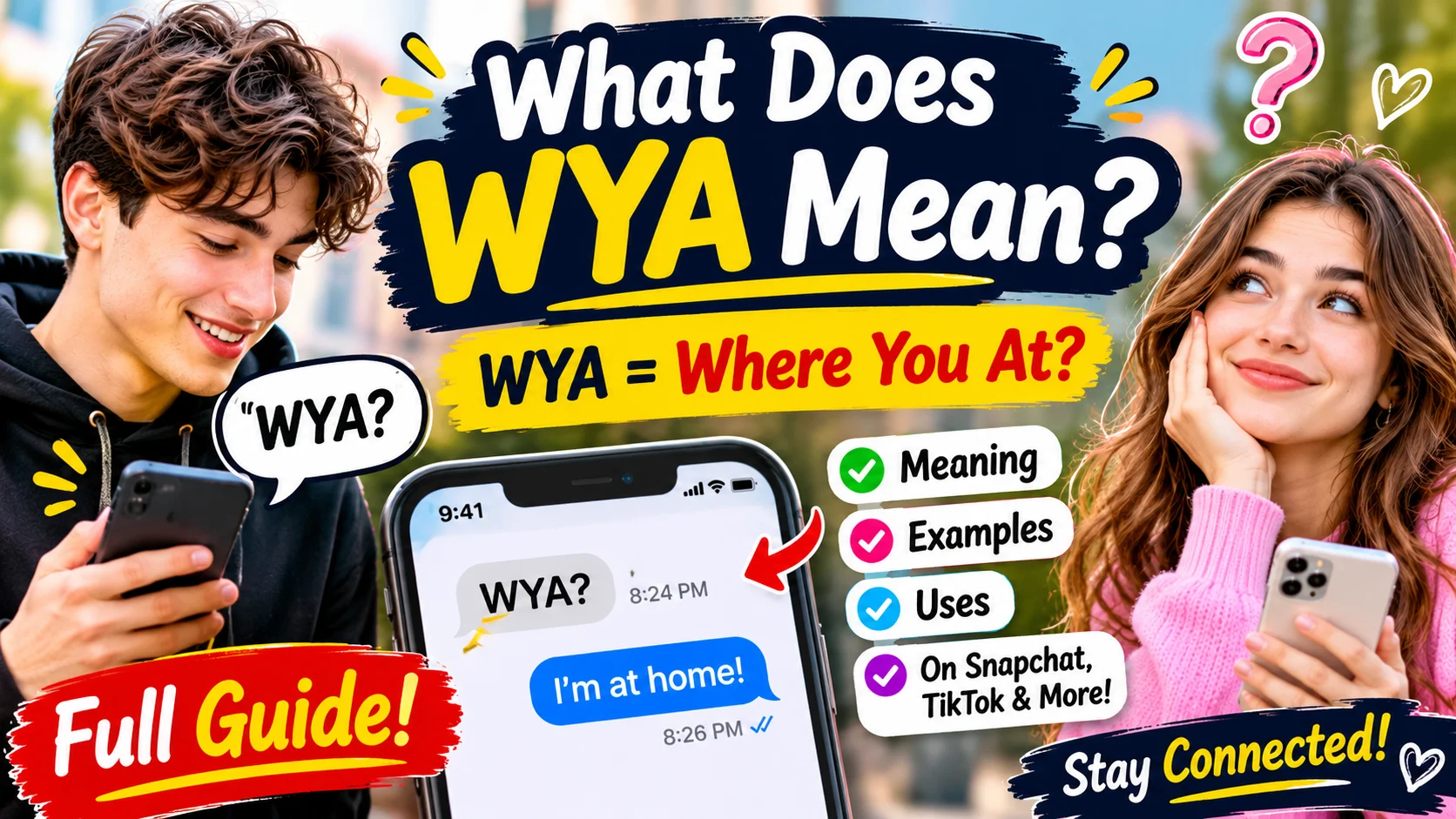
WYA means “Where You At?” It is a popular internet abbreviation people use in text messages and social media. It asks someone about their current location, availability, or plans. Friends, family members, and romantic interests commonly use it in casual conversations.
What does WYA mean? It is one of the most common abbreviations you’ll encounter in modern texting and online conversations. If someone sends you this short message, they usually want to know where you are or what you’re doing.
However, its meaning can change slightly depending on the conversation. Sometimes, a friend wants to meet you. In other situations, someone may simply want to start a conversation.
Furthermore, social media platforms have made short expressions like this increasingly popular. People use them because they save time and make digital communication feel more natural.
For example, imagine you’re relaxing at home when a friend sends you “WYA?” They probably want to know your location. They might also be checking whether you’re available to hang out.
Quick Answer: Understanding WYA at a Glance
| Category | Explanation |
|---|---|
| Meaning | Where You At? |
| Full Form | Where are you? |
| Context | Casual texting and online conversations |
| Primary Platforms | Snapchat, TikTok, Instagram, WhatsApp |
| Example | “Hey, WYA? We’re waiting for you.” |
| Tone | Casual, friendly, curious |
| Main Purpose | Asking about someone’s location or availability |
| Common Audience | Friends, couples, family, and online communities |
What Does WYA Mean in Texting? Full Definition and Origin
The abbreviation WYA stands for “Where You At?” People use it to ask about someone’s current location or availability.
Although the phrase uses informal grammar, it sounds natural in everyday digital conversations. It communicates the same general idea as asking, “Where are you?”
For instance:
Person A: Hey, WYA?
Person B: I’m at home. What’s up?
This exchange shows how easily three letters can communicate a complete question.
Why Do People Use This Abbreviation?
Modern communication often favors short, direct messages. People want to express their thoughts quickly without typing complete sentences.
Consequently, abbreviations have become a normal part of online language.
Here are some common reasons people use it:
- Convenience: Typing three letters takes less time than writing a complete question.
- Informal communication: It creates a relaxed atmosphere between friends.
- Quick coordination: People can check someone’s location before meeting.
- Conversation starters: It provides an easy way to reconnect with someone.
- Social media culture: Short expressions fit naturally into comments, direct messages, and temporary posts.
Furthermore, younger internet users often combine abbreviations with emojis, slang, and short phrases.
Where Did WYA Come From?
There isn’t one universally documented person or event responsible for creating this abbreviation.
However, its popularity connects closely with the growth of internet messaging, mobile phones, and SMS communication.
Early text messaging encouraged people to shorten everyday expressions. Character limits and slower typing methods made abbreviations especially useful.
As messaging platforms developed, these expressions moved into online communities and social networks.
Eventually, WYA became familiar across different digital communication channels.
Today, people use it in private messages, group chats, gaming conversations, and casual social media interactions.
Is WYA Proper English?
WYA is informal internet slang rather than standard written English.
The expression “Where You At?” is common in casual speech and digital communication. However, formal writing generally uses “Where are you?”
For example:
| Informal Expression | Standard English |
|---|---|
| WYA? | Where are you? |
| WYA rn? | Where are you right now? |
| WYA tonight? | Where will you be tonight? |
| WYA later? | Where will you be later? |
Therefore, use the abbreviation with people who understand casual texting language. For professional communication, choose complete sentences.
Contextual Dynamics and Nuances of the Term
Although the basic definition remains consistent, the intention behind a message can change.
Understanding the surrounding conversation helps you identify what someone actually wants.
1. Asking About Someone’s Location
This is the most straightforward use.
Someone may want to know your physical location because they’re nearby or planning to visit.
Example:
“Hey, WYA? I’m outside.”
Here, the sender wants to locate you.
2. Checking Your Availability
Sometimes, people use the expression to discover whether you’re free.
For example:
“Hey, WYA tonight? Want to grab dinner?”
The sender isn’t necessarily asking for your exact address. They’re checking your plans and availability.
3. Starting a Casual Conversation
A friend might send this abbreviation simply to reconnect.
For example:
“Heyyy, WYA? Haven’t talked to you all week!”
In this situation, the message works as an informal conversation starter.
Furthermore, the sender may want to know what you’ve been doing lately.
4. Showing Romantic Interest
Romantic interests sometimes use it to start conversations or suggest meeting.
For example:
“Hey, WYA? I was thinking about seeing you today.”
However, the abbreviation itself doesn’t prove romantic attraction. The surrounding messages, relationship, and previous interactions matter more.
5. Making Last-Minute Plans
Friends frequently use short messages when coordinating spontaneous activities.
For example:
“WYA? We’re heading to the mall.”
The sender wants to know whether you can join them.
6. Checking on Someone
Close friends and family members may use it to check whether someone has arrived safely.
For example:
“WYA? You said you’d be home an hour ago.”
Depending on the situation, this message may express concern rather than simple curiosity.
Real-Life Conversation Examples Using WYA
The easiest way to understand internet slang is to see how people use it in everyday conversations.
Below are five realistic texting scenarios.
Example 1: Talking With a Friend
Alex: Hey bro, WYA?
Jordan: I’m at home. What’s up?
Alex: We’re going to play basketball. Wanna come?
Jordan: Sure! Give me 15 minutes.
Meaning: Alex wants to know Jordan’s location before inviting him to play basketball.
Example 2: Making Weekend Plans
Emma: Hey, WYA tonight?
Sophia: I’m getting ready at home.
Emma: We’re going to a concert. You should join us!
Sophia: Sounds fun! What time?
Meaning: Emma checks Sophia’s availability before inviting her out.
Example 3: Romantic Conversation
Ryan: Hey, WYA?
Mia: Just relaxing at home. Why?
Ryan: I was hoping we could grab coffee together.
Mia: That sounds nice!
Meaning: Ryan uses the abbreviation to open a conversation and suggest spending time together.
Example 4: Checking on a Family Member
Mom: WYA? Are you still at school?
David: Yes, Mom. I’m waiting for the bus.
Mom: Okay. Text me when you get home.
David: Sure!
Meaning: The parent wants to know the child’s location and make sure everything is okay.
Example 5: Group Chat Conversation
Liam: Guys, WYA?
Noah: We’re near the movie theater.
Liam: Already there?
Noah: Yeah, we’re getting snacks.
Liam: Wait for me. I’ll be there soon!
Meaning: Liam wants to find his friends and join their activity.
Platform-Specific Breakdown
Different social media platforms encourage different communication styles. However, the basic meaning of this abbreviation stays the same.
Let’s explore how people use it across popular platforms.
How It Is Used on Snapchat
Snapchat is popular for quick conversations, disappearing messages, and casual communication.
People often send short messages instead of writing complete sentences.
For example:
Friend: WYA?
You: At Starbucks. You?
Friend: I’m nearby!
On Snapchat, the abbreviation can serve several purposes:
- Checking where a friend is.
- Finding out whether someone wants to hang out.
- Starting a casual conversation.
- Responding to someone’s Snapchat Story.
- Coordinating plans with friends.
Furthermore, Snapchat’s location-sharing features may provide additional context. However, receiving this message doesn’t automatically mean someone expects you to share your exact location.
You can answer generally if you prefer to keep your location private.
The Role of WYA on TikTok
TikTok has helped spread internet expressions through comments, videos, captions, and creator interactions.
People may use this abbreviation when discussing meetups, reacting to content, or contacting friends.
For example:
TikTok Comment: WYA? We need more videos like this!
Creator: Working on the next one!
Here, the commenter isn’t asking about the creator’s physical location. Instead, the phrase functions as a casual way to get someone’s attention.
Another example might appear in a video caption:
“WYA? We’re going out tonight!”
This wording creates a conversational feeling and invites viewers to participate.
However, remember that TikTok comments can use slang creatively. Always consider the surrounding content before interpreting a short expression literally.
Instagram and Texting Dynamics
Instagram users frequently communicate through direct messages, Story replies, and comments.
The abbreviation fits naturally into these short interactions.
For example:
Person A: WYA?
Person B: Just got home.
Person A: How was your trip?
In this conversation, the sender uses a location question to begin a longer discussion.
You may also see variations such as:
| Expression | Meaning |
|---|---|
| WYA? | Where are you? |
| WYA rn? | Where are you right now? |
| WYA later? | Where will you be later? |
| WYA tonight? | Where will you be tonight? |
| WYA lol? | Where are you? A playful or casual tone |
| WYA 👀 | Where are you? With a curious or suggestive tone |
The emoji can change the emotional feeling of a message. However, it doesn’t create a completely different definition.
WYA on WhatsApp and iMessage
WhatsApp and Apple’s iMessage support everyday conversations between friends, relatives, and coworkers.
People often use abbreviations to keep messages short.
For example:
“Hey, WYA? Dinner is ready.”
Or:
“WYA rn? Need to ask you something.”
These messages are direct and easy to understand.
However, when communicating with someone unfamiliar with internet slang, writing the complete question may prevent confusion.
Alternative Meanings and NLP Variations of the Phrase
The abbreviation has one widely recognized meaning in everyday texting. Nevertheless, related expressions can communicate slightly different intentions.
Understanding these variations makes digital conversations easier.
Common Variations
| Slang | Full Meaning | Typical Use |
|---|---|---|
| WYA | Where You At? | Asking about someone’s location |
| WYD | What You Doing? | Asking about someone’s activity |
| WYA RN | Where You At Right Now? | Asking about someone’s current location |
| HRU | How Are You? | Checking someone’s well-being |
| HBU | How About You? | Returning a question |
| LMK | Let Me Know | Requesting an update |
| BRB | Be Right Back | Temporarily leaving a conversation |
| TTYL | Talk To You Later | Ending a conversation |
| IDK | I Don’t Know | Expressing uncertainty |
| IMO | In My Opinion | Sharing a personal viewpoint |
| HMU | Hit Me Up | Asking someone to contact you |
WYA vs. WYD: What’s the Difference?
These two expressions look similar, but they ask different questions.
WYA asks about someone’s location.
WYD asks about someone’s current activity.
Consider these examples:
Message 1: WYA?
Reply: I’m at the gym.
Message 2: WYD?
Reply: I’m working out.
The first question focuses on location. The second focuses on activity.
However, people sometimes use them together:
“WYA and WYD?”
This means the sender wants to know both where you are and what you’re doing.
WYA RN Meaning
The letters RN stand for “Right Now.”
Therefore, WYA RN means “Where You At Right Now?”
For example:
“Hey, WYA RN? I need to talk to you.”
The additional abbreviation makes the question more immediate.
WYA in a Romantic Context
Romantic partners may use this expression to check whether the other person is available.
For example:
“Hey babe, WYA? Missing you!”
However, the phrase doesn’t automatically indicate affection. Friends, relatives, and acquaintances use it too.
The relationship and surrounding conversation determine its emotional meaning.
Misinterpretations: When NOT to Use WYA
Internet slang makes communication faster. However, using informal expressions in the wrong situation can create confusion.
Here are some situations where you should avoid this abbreviation.
1. Professional Emails
Avoid using it in formal workplace emails.
For example, don’t write:
“Hey, WYA? Need the report.”
Instead, write:
“Hi, where are you currently? I need to discuss the report.”
A professional message should communicate its purpose clearly.
2. Conversations With Unfamiliar People
Not everyone understands internet abbreviations.
Older relatives, new acquaintances, or people who rarely use social media may not recognize the expression.
Therefore, writing the complete question is often more helpful.
3. Sensitive Situations
If someone is dealing with an emergency, avoid relying on unclear abbreviations.
Instead, ask direct questions.
For example:
“Are you safe? Where are you right now?”
Clear language matters more than saving a few seconds.
4. When Someone Values Their Privacy
Not everyone feels comfortable sharing their location.
If someone doesn’t want to disclose where they are, respect that choice.
You can ask whether they’re available without requesting their exact location.
For example:
“Are you free to talk?”
This approach feels less intrusive.
5. When the Conversation Requires Clarity
Short expressions can sometimes create misunderstandings.
For instance, a person may interpret a message as an invitation when the sender only wants to check their location.
Consequently, adding a few words can make your intention clearer.
How to Respond in Chat Comfortably
Now that you understand the expression, let’s explore how to reply naturally.
Your response should depend on your relationship with the sender and the purpose of their question.
1. Give a Simple Location Update
If someone wants to know where you are, answer directly.
Examples:
- “I’m at home.”
- “Just got to work.”
- “I’m at the coffee shop.”
- “On my way!”
- “I’m with some friends.”
You don’t need to provide an exact address.
2. Respond With Humor
If you’re talking to a close friend, a playful response can make the conversation more enjoyable.
Examples:
- “Somewhere between hungry and sleepy!”
- “Currently living my best couch life.”
- “Lost in my own little world.”
- “At home, avoiding responsibilities!”
- “In my snack headquarters!”
These replies work best when both people enjoy casual humor.
3. Show Interest in Making Plans
If someone seems interested in meeting, encourage the conversation.
Try these responses:
- “I’m free! What’s the plan?”
- “Not far from you. Want to meet?”
- “Just finished work. Where are we going?”
- “I’m nearby. Coffee?”
- “At home for now. What’s happening?”
These answers communicate availability without making assumptions.
4. Reply When You’re Busy
You don’t have to stop everything to answer immediately.
Instead, send a polite response.
Examples:
- “I’m working right now. I’ll text you later.”
- “Out with family. What’s up?”
- “A little busy at the moment.”
- “Can’t talk right now, but I’ll message you soon.”
Furthermore, a short explanation can prevent unnecessary misunderstandings.
5. Respond When You Don’t Want to Share Your Location
Your location is personal information. You can maintain privacy while keeping the conversation friendly.
Try these responses:
- “I’m out right now. What’s up?”
- “Just taking care of a few things.”
- “Not somewhere I can meet at the moment.”
- “I’m busy, but everything’s good!”
- “Why do you ask?”
You can also ignore the question if it makes you uncomfortable.
6. Ask a Follow-Up Question
Sometimes, the best response is another question.
For example:
Friend: WYA?
You: At home. Why?
This gives the other person an opportunity to explain why they contacted you.
It also keeps the conversation moving naturally.
10 High-Intent FAQs About the Slang
1. What Does WYA Mean From a Guy?
When a guy sends this abbreviation, he generally wants to know your location or availability.
He might want to meet, start a conversation, or check what you’re doing.
However, it doesn’t automatically mean he’s romantically interested. Consider your existing relationship and the rest of the conversation.
2. What Does WYA Mean From a Girl?
When a girl uses this expression, she is usually asking where you are or whether you’re available.
She might want to make plans, continue a conversation, or simply check on you.
The meaning depends on the context rather than the sender’s gender.
3. Does WYA Mean Where Are You?
Yes. WYA stands for “Where You At?”
People commonly use it as an informal alternative to “Where are you?”
It generally asks about someone’s current physical location, although it can sometimes refer to availability.
4. What Does WYA Mean on Snapchat?
On Snapchat, people commonly use it in direct messages and casual conversations to ask about someone’s location.
Friends may also use it to arrange meetups or start conversations.
5. What Does WYA RN Mean?
WYA RN means “Where You At Right Now?”
RN stands for “Right Now.” Therefore, the complete message asks about someone’s current location.
6. Is WYA Flirting?
Not necessarily.
Someone may use it to show romantic interest, but friends and family members use it too.
Look at the conversation’s tone, relationship, and previous messages before assuming it’s flirtatious.
7. How Should I Reply to WYA?
Give a simple answer based on your situation.
For example, you can say “I’m at home,” “On my way,” or “Just hanging out.”
If you don’t want to share your location, you can respond generally or ask why they want to know.
8. What Is the Difference Between WYA and WYD?
WYA asks where someone is.
WYD asks what someone is doing.
For example, “WYA?” might receive the answer “At home.” Meanwhile, “WYD?” might receive “Watching a movie.”
9. Is WYA Rude or Disrespectful?
Generally, no.
It’s a casual abbreviation that friends and acquaintances commonly use.
However, the tone and situation matter. Repeatedly demanding someone’s location can feel intrusive, especially when they don’t want to share it.
10. Can I Use WYA in Professional Conversations?
It’s better to avoid it in formal professional communication.
Instead, write “Where are you currently?” or “Are you available?”
Complete sentences create a clearer and more professional impression.
Image SEO Architecture: Featured Infographic Image
A visually appealing featured image can help readers understand the topic before they begin reading.
For this article, use a friendly, modern infographic that explains the abbreviation in a simple way.
Recommended Featured Image Concept
Main Heading: What Does WYA Mean?
Supporting Text: WYA = Where You At?
Visual Elements:
- A realistic young man and woman having a friendly conversation.
- A smartphone displaying a casual text message.
- A speech bubble containing “WYA?”
- A second speech bubble saying “I’m at home!”
- Small location pin and messaging icons.
- A bright, modern background with readable typography.
Image SEO Details
| Element | Recommendation |
|---|---|
| Image Title | What Does WYA Mean in Texting |
| Filename | what-does-wya-mean.png |
| Alt Text | A young couple texting on their phones with an infographic explaining WYA as Where You At |
| Caption | Learn what WYA means in texting, Snapchat, and social media. |
| Primary Keyword | What Does WYA Mean |
| Image Format | WebP or compressed PNG |
| Suggested Dimensions | 1200 × 675 pixels |
| Image Placement | Near the introduction |
Use a descriptive filename and natural alt text. Furthermore, compress the image before uploading it to improve page performance.
Conclusion
Internet language continues to evolve as people find faster ways to communicate online.
WYA is a simple example of how three letters can replace an everyday question. It stands for “Where You At?” and usually asks about someone’s location or availability.
Throughout texting and social media, people use it to make plans, reconnect with friends, and start casual conversations.